
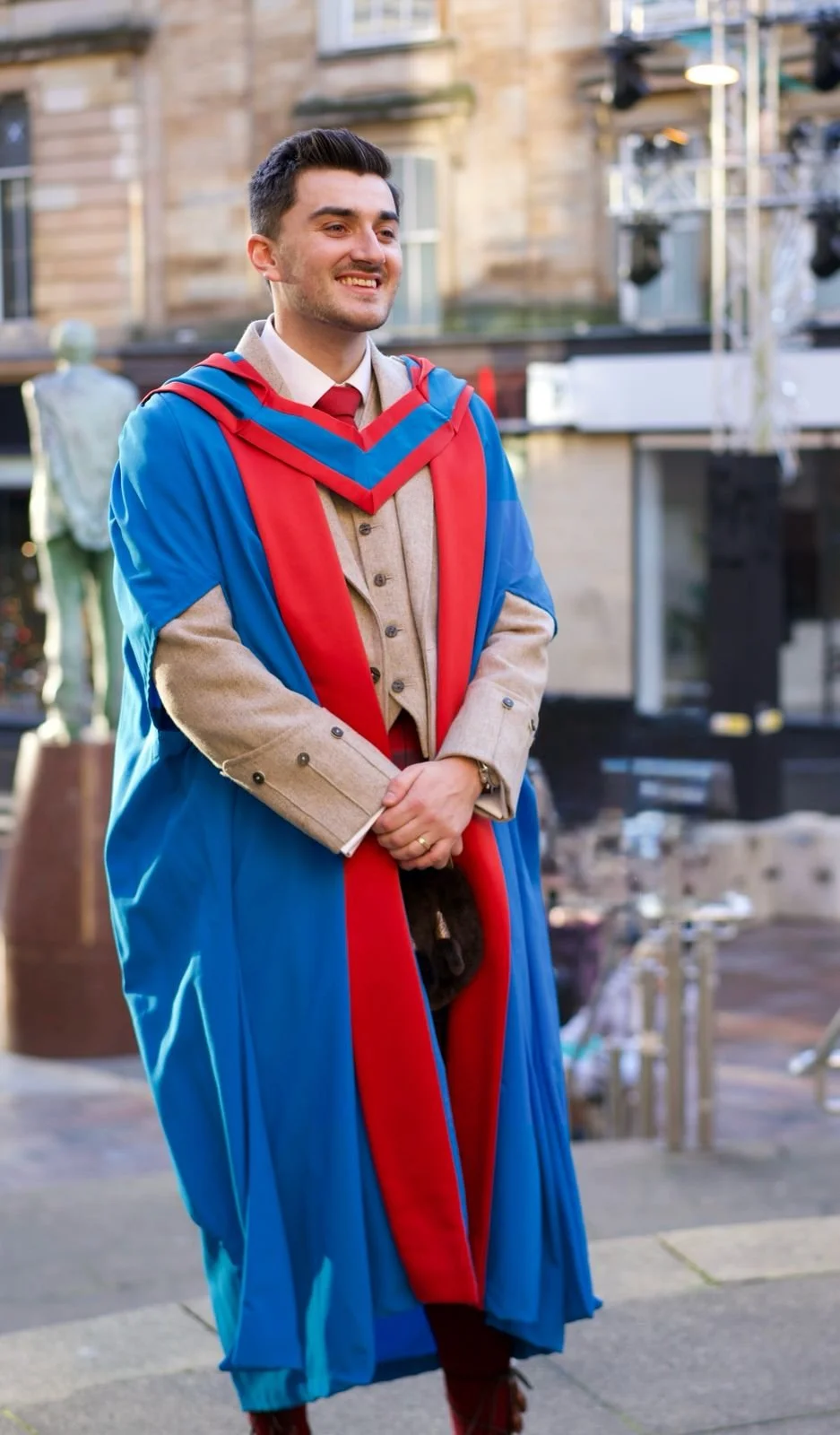
Dr Harvey Smith | Sport and Exercise Psychologist | Glasgow
What a Doctorate Means in the Room
For anyone thinking about seeing a psychologist, it's worth knowing what you're actually getting.
I have a doctorate. It took years of research, supervised practice, and defending my thinking to people whose job was to challenge it.
It matters, and I'm proud of it. But the title is not the reason clients continue working with me.
What keeps them coming back is the person across from them.
Doctoral training taught me to read the evidence, question it, and determine whether it fits the person in front of me. It also taught me how to work in an integrative way, drawing on different approaches depending on what each client needs and not forcing everyone through the same model. Alongside that, it gave me a grounding in four core skills:
Assessment: understanding what is going on for a client, and what they want from the work.
Formulation: making sense of why things are the way they are, together with the client.
Interventions: choosing approaches that fit the client, not just ones I'm comfortable with.
Reviewing the work: checking whether it's helping, and changing course if it isn't.
The training also taught me to notice my own assumptions so they don't get in the way. For clients, that means their sessions are shaped by what has been shown to help and by their own situation, not by habit or a one-size-fits-all plan.
How I work
My work is rooted in the person-centred approach. In practice, that means I start with the client, not the theory. I listen closely, I try to understand how things look from their side, and I'm honest and straightforward with them. I don't judge, and I don't rush. Clients set the pace, and we work out together what to focus on and what helps.
The approach comes from Carl Rogers, who believed people change when they feel understood and accepted.
The integrative skills tell me what might help. The person-centred approach tells me how to offer it.
Why it matters
The research is clear that feeling understood and comfortable with your practitioner makes a real difference to how well sessions work . The relationship is not a nice extra. It is part of the work itself.
Working with me
I see clients at The Hidden Lane in Finnieston, Glasgow, and I also offer walk-and-talk sessions in Kelvingrove Park for those who would rather talk while moving. I work with athletes, performers, and anyone who wants support with pressure, confidence, identity, or change.
If you'd like to see what it feels like, I offer a free 15-minute consultation. No pressure. Just a conversation about what you're looking for.
📞 0141 673 3973
🌐 drharveysmith.com
Give me a shout.
This post draws on peer-reviewed research. Key sources are listed below.
Flückiger, C., Del Re, A. C., Wampold, B. E., & Horvath, A. O. (2018). The alliance in adult psychotherapy: A meta-analytic synthesis. Psychotherapy, 55(4), 316–340.
Rogers, C. R. (1957). The necessary and sufficient conditions of therapeutic personality change. Journal of Consulting Psychology, 21(2), 95–103.