
Walk and Talk: Fresh Air, Honest Conversations, and the Occasional Puddle
Dr Harvey Smith | Sport and Exercise Psychologist | Glasgow
If you've ever noticed that some of your best thinking happens on a walk, you're not imagining it. Something about movement and fresh air loosens things up; conversations that feel stuck in a room can open up naturally when you're side by side, moving through the world. That's the heart of Walk and Talk therapy, and it's something I genuinely believe in.
What is Walk and Talk therapy?
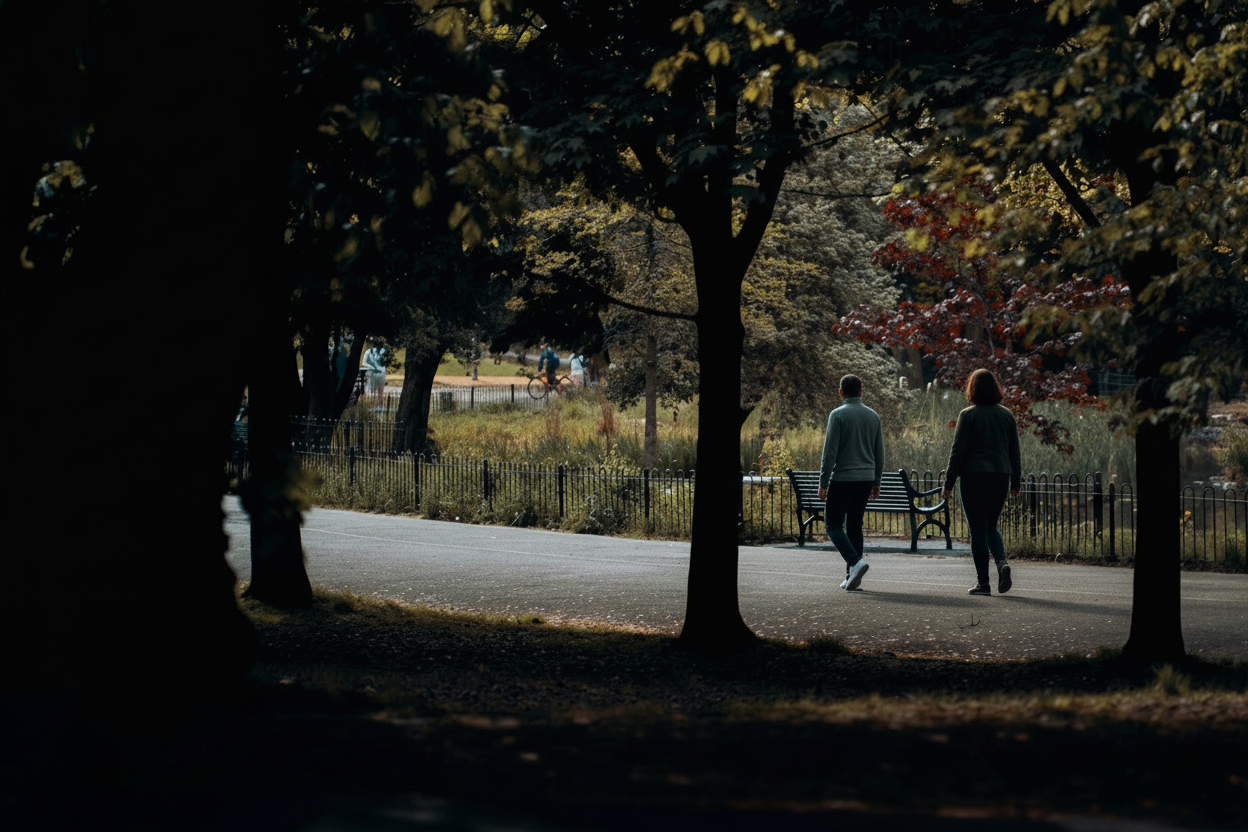
It's exactly what it sounds like; a therapeutic session that takes place outdoors rather than in a therapy room. We walk together through a park or green space in Glasgow, and the conversation unfolds from there. It's still structured, still confidential, and still grounded in the same evidence-based approaches I use in any session, but the setting changes. And the setting, it turns out, matters more than you might think.
The benefits of moving whilst we talk
Walking activates a bilateral rhythm in the body; left, right, left, right. This kind of rhythmic movement is linked to reduced physiological arousal, better emotional regulation, and a greater capacity to process difficult thoughts and feelings. Movement can make it easier to think, feel, and speak honestly.
Walk and Talk is a shoulder-to-shoulder therapy. Sitting face-to-face can feel exposing, particularly early in therapy. Walking side by side removes that dynamic entirely. Many people find it easier to say the hard thing when they're looking ahead rather than directly at another person.
Green and blue spaces: more than just a backdrop
The environment matters too. Attention Restoration Theory, developed by researchers Stephen and Rachel Kaplan, explains why time in natural settings reduces mental fatigue and restores our capacity to focus. Urban environments demand constant directed attention, the kind that depletes us. Natural settings engage a gentler, effortless attention that allows the mind to rest and recover.
Blue spaces bring something extra. Rivers, canals, and lochs have been consistently associated with lower psychological distress, improved mood, and a sense of calm. Glasgow is genuinely well-placed for all of this; the Kelvin Walkway, the Clyde, and the city's parks offer real, accessible spaces where meaningful therapeutic work can happen.
A note for sport and exercise performers
For athletes and active people, Walk and Talk carries particular relevance. Many performers I work with find therapy rooms subtly at odds with how they relate to themselves; they are people of movement and physicality. Taking sessions outdoors honours that, and it reinforces something I care about: the mental and the physical are always in conversation, never separate.
Is it right for you?
Walk and Talk isn't for everyone, and that's okay. Some people prefer the privacy and relaxed atmosphere of a room, and that's a perfectly valid choice. But if the idea of doing therapeutic work outdoors appeals to you, it's absolutely something we can explore.
We work at your pace, on your terms.
📞 0141 673 3973
🌐 drharveysmith.com
Let's have a wee chat.
This post draws on peer-reviewed research. Key sources are listed below.
Dickmeyer, A., Smith, J. J., Halpin, S., McMullen, S., Drew, R., Morgan, P., Valkenborghs, S., Kay-Lambkin, F., & Young, M. D. (2025). Walk-and-talk therapy versus conventional indoor therapy for men with low mood: A randomised pilot study. Clinical Psychology and Psychotherapy.https://doi.org/10.1002/cpp.70035
Kaplan, R., & Kaplan, S. (1989). The experience of nature: A psychological perspective. Cambridge University Press.
Kaplan, S. (1995). The restorative benefits of nature: Toward an integrative framework. Journal of Environmental Psychology, 15(3), 169–182. https://doi.org/10.1016/0272-4944(95)90001-2
Nichols, W. J. (2014). Blue mind: The surprising science that shows how being near, in, on, or under water can make you happier, healthier, more connected, and better at what you do. Little, Brown and Company. https://www.wallacejnichols.org/122/bluemind.html
Prince-Llewellyn, H., & McCarthy, P. (2024). Walking and talking for well-being: Exploring the effectiveness of walk and talk therapy. Counselling and Psychotherapy Research. https://doi.org/10.1002/capr.12847